


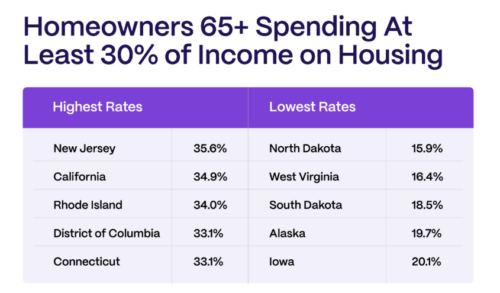
A record 12.5 million senior households are spending at least 30 percent of their income on housing, U.S. Census data shows – up from 9.3 million a decade earlier, according to a report authored by Christine Healy, chief growth officer at senior living technology company Seniorly.
- “That’s a sign that housing affordability challenges don’t disappear at retirement age and can be extra problematic for older adults on fixed incomes,” wrote Healy.
- For homeowners who paid off their mortgages entirely, median housing costs have still climbed 35 percent since 2019 – about 1.5 times faster than their incomes grew.
“Property taxes, utilities and insurance are now eating away at their savings – and unlike younger Americans, many seniors can’t simply take on a second job or trade up to a higher salary to compensate,” adds Healy.
The big picture: Seniors are more likely to be cost-burdened in California than almost anywhere else with 34.9 percent of older homeowners spending at least 30 percent of their income on housing. Driven by the nation’s lowest property taxes ($881) and the smallest share of households facing high insurance costs (10.2 percent pay $2,000+), senior households in West Virginia are the least cost burdened.
- An article published by USA Today highlighting these statistics, points out that a reverse mortgage is one possible solution to help seniors cope with higher housing costs.
- “If you love and want to keep the house you own, consider a reverse mortgage if you can’t afford monthly home equity loan payments,” says the USA Today article.