


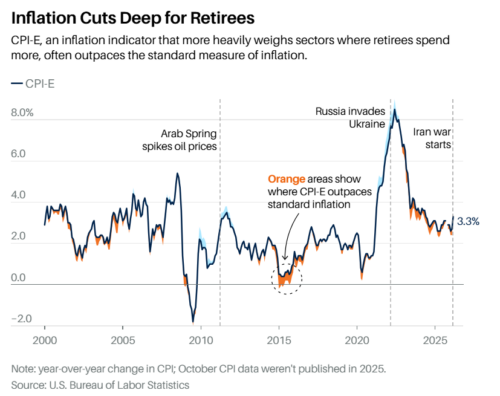
Since November 2022, the Bureau of Labor Statistics reports that CPI-E—an experimental index designed to better reflect inflation experienced by Americans age 62 and older—has outpaced the standard consumer price index for 40 consecutive months, according to a Barron’s article.
By the numbers: Over that period, retirees’ cost of living rose 10.8 percent in total, about 1.2 percentage points higher than the broader CPI.
Go deeper: That trend paused in March, when a spike in gasoline prices tied to the war with Iran brought both measures to parity, each showing 3.3 percent year-over-year inflation. Because workers tend to drive more than retirees, rising fuel costs had a greater impact on the standard index.
Still, experts caution that inflation pressures for older Americans are far from over. With CPI-E placing greater weight on medical care and housing, retirees are likely to feel a delayed impact as higher energy costs ripple through the broader economy.
Financial advisors say many retirees may not fully recognize how deeply oil prices affect their finances.
- “Most retirees think oil prices just affect gas. That is not true,” said Kevin Thompson, president and CEO of 9i Capital Group.
- “Oil is embedded in almost everything you spend money on. And if you’re retired, it hits you harder than just about everyone else.”